Is the U.S. Headed For a Recession in 2026?
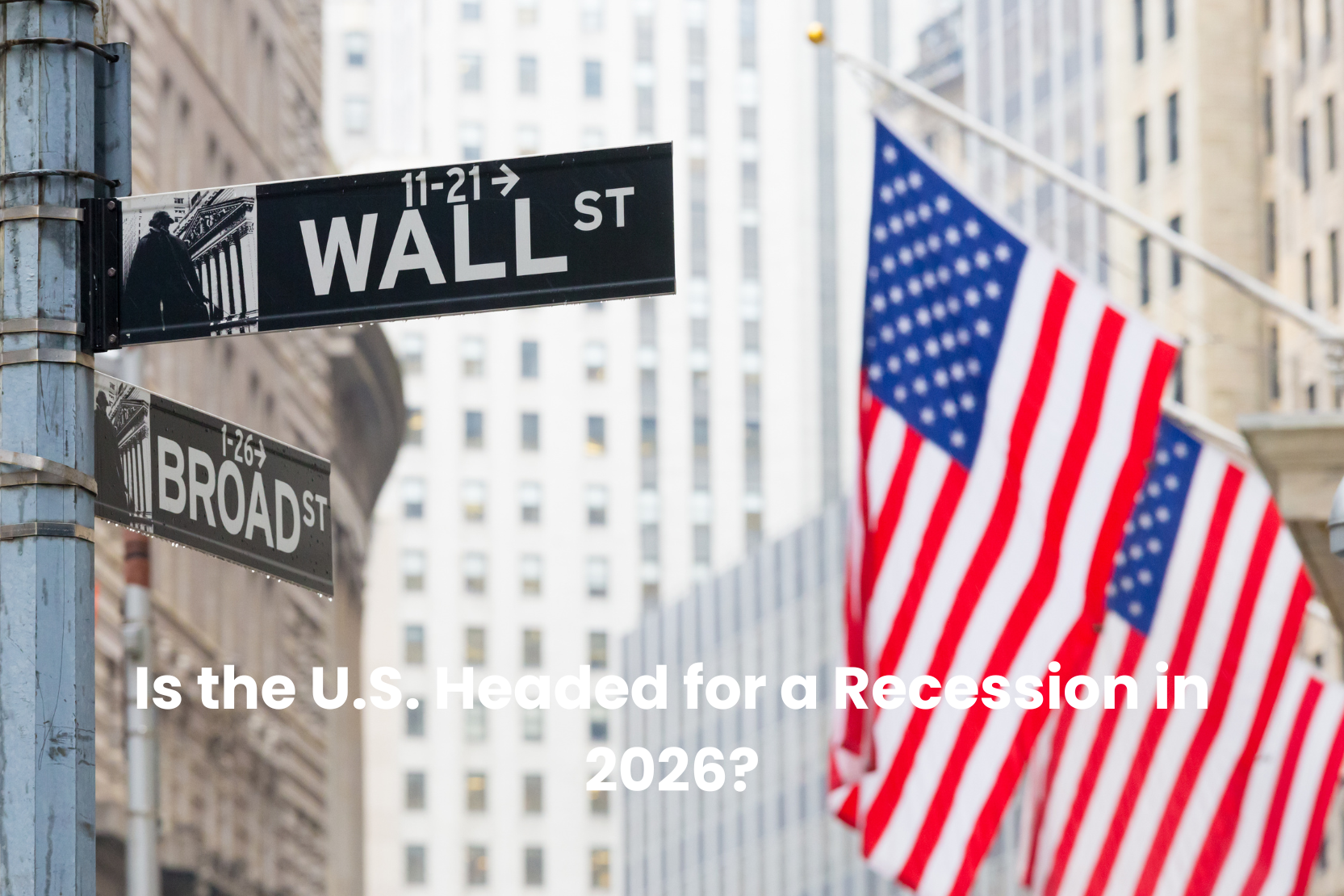
Where Is the American Economy Headed in 2026?
It’s no secret that today’s economy is complex. With tariffs changing regularly, AI investments surging, and employment statistics creating sleepless nights for many economists, determining the path forward for our economy requires a serious look at actual economic data — rather than a hunch or a feeling.
The Data Tells a Mixed Story
Right now, the majority of economists believe we will avoid a full-blown recession; however, the chances of avoiding a recession do not provide much comfort.
Moody’s Analytics says the probability of a recession occurring in 2026 is 42%, almost three times the 15% chance of a recession in a strong economy.
J.P. Morgan Global Research also reports that recession probability has dropped to 35% from their previous estimate of 40%.
The National Association for Business Economics projects GDP growth of 2% in 2026, which is a little better than the "stagnation" threshold, although some analysts like RSM US, are slightly more optimistic and predict a 2.2% GDP growth rate in 2026 with a 30% chance of recession.
Even RSM admits the economy is currently treading water. Overall: The economy is unlikely to collapse, but it is also unlikely to thrive.
Your Job Prospects Aren't Looking Great
The labor market — which determines whether you have enough money to pay rent — is sending off warning signals. Bankrate’s Economic Indicator Survey predicts that employers will reduce hiring to approximately 49,000 jobs per month by September 2026, which represents roughly half of the current monthly hiring pace.
The unemployment rate is forecasted to rise from 4.3% to 4.6% with The Conference Board projecting an increase to 4.7% by early 2026.
How does this affect you? Hiring freezes and layoffs have already been announced by many companies. If you are searching for a job or fear losing your job, the available job opportunities will be fewer than ever before.
The Wealth Gap Is Breaking the Economy
Here is a number that shows why the economy feels so bad even when the GDP numbers appear to be fine: The top 10 percent of American households now accounts for almost half of all consumer spending, as reported by Moody’s Analytics. That is not a good sign for the overall economy.
Consumers represent about 70 percent of the total economy. A wealth gap of such size creates a “bifurcated” economy — essentially two different economies.
While upper-income households continue to book expensive vacations and purchase luxury items, lower-income households are reducing their spending on necessities.
Why does this matter? Consumer confidence that applies to all consumers drives both job creation and business investment. When consumer spending is driven by only a few high-spending households, the economy becomes unstable.
Inflation Isn't Actually Fixed
Even though you may hear otherwise, prices continue to rise faster than the Federal Reserve wants them to. The Fed is expecting inflation to average 2.4% in 2026 – above its 2% target.
The Conference Board believes inflation will peak over 3% in the first half of 2026, and then fall to 2.3% by the end of the year.
Only 13 percent of Bankrate’s surveyed economists expect inflation to return to normal by the end of 2026. Almost half of the respondents expect it to take at least 2027 or longer to normalize.
Translation: Your grocery bill, rent, etc., will continue to get more expensive and your salary will likely not keep pace.
The AI Bubble Question
Massive spending on artificial intelligence is currently propping up the economy, but many are starting to question whether this trend will hold.
Researchers at Goldman Sachs say that the value of stocks is close to being at the same level as the dot-com bubble levels, although it is not quite there yet.
The risk is simply that if AI investments do not produce the anticipated returns, companies will cut back on their spending and possibly trigger the recession that everyone is trying to avoid.
On the other hand, if AI produces real productivity improvements, it may create more robust economic growth than anyone anticipates.
What Could Make Things Worse
As Bloomberg notes, the economy depends on four pillars: labor market strength, inflation rates, consumer spending, and AI investment.
As Moody’s chief economist Mark Zandi states, "If any of those pillars fails or goes the wrong way, we’re done."
Some of the specific risks include: tariffs remaining elevated (which increases prices), immigration restrictions tightening labor markets (which drives up wages and costs), and the Federal Reserve keeping interest rates higher for longer (which makes borrowing more expensive).
The Optimistic Case (Yes, There Is One)
Not everything is doom and gloom. Tax relief provided by the recent tax law will help increase the disposable income of consumers.
RSM economists note that there is a 45 percent probability of above-average growth if everything lines up correctly, with some scenarios predicting growth as high as 2.5%.
The Federal Reserve is expected to implement additional interest rate reductions. J.P. Morgan expects the Fed to reduce rates to 3.25-3.5 percent by the second quarter of 2026, which would make borrowing easier and may stimulate economic activity.
What Does This Mean For You?
Regardless of whether we officially experience a recession in 2026, it will likely feel difficult for most individuals.
Price hikes will continue, job openings will be limited, and wage growth will be unable to keep pace with rising living costs.
Honestly, nobody really knows for sure what will happen. However, understanding the actual probabilities, risks, and economic indicators provides you with a much clearer picture than just reading headlines.
Stay informed, save an emergency fund if possible, and make strategic career decisions. The economy might avoid recession, but that doesn't mean it's going to be thriving.
Sources: Moody's Analytics, J.P. Morgan Global Research, National Association for Business Economics, Bankrate, RSM US, The Conference Board, Bloomberg, Federal Reserve
Read more:
Should You Buy Chicago Real Estate in 2026?